


Page 117 - 86395_CCB - 2024 Annual Report (web)
P. 117
117

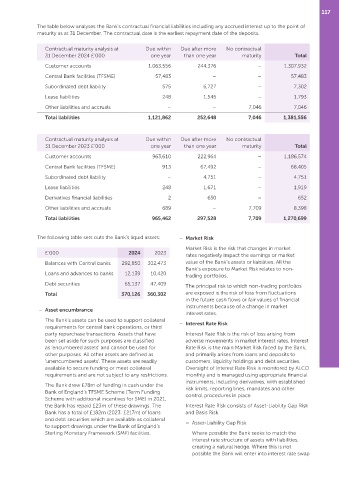
              The table below analyses the Bank’s contractual financial liabilities including any accrued interest up to the point of
              maturity as at 31 December. The contractual date is the earliest repayment date of the deposits.

                 Contractual maturity analysis at   Due within   Due after more   No contractual
                 31 December 2024 £’000               one year    than one year       maturity           Total
                 Customer accounts                   1,063,556        244,376               –        1,307,932
                 Central Bank facilities (TFSME)        57,483              –               –          57,483
                 Subordinated debt liability              575           6,727               –           7,302

                 Lease liabilities                        248           1,545               –           1,793
                 Other liabilities and accruals             –               –           7,046           7,046
                 Total liabilities                   1,121,862        252,648           7,046        1,381,556


                 Contractual maturity analysis at   Due within   Due after more   No contractual
                 31 December 2023 £’000               one year    than one year       maturity           Total

                 Customer accounts                     963,610        222,964               –        1,186,574
                 Central Bank facilities (TFSME)          913          67,492               –          68,405
                 Subordinated debt liability                –           4,751               –           4,751
                 Lease liabilities                        248           1,671               –           1,919

                 Derivatives financial liabilities          2             650               –             652
                 Other liabilities and accruals           689               –           7,709           8,398
                 Total liabilities                    965,462         297,528           7,709        1,270,699


              The following table sets outs the Bank’s liquid assets:    – Market Risk

                                                                  Market Risk is the risk that changes in market
                 £’000                        2024     2023
                                                                  rates negatively impact the earnings or market
                 Balances with Central banks  292,850  302,473    value of the Bank’s assets or liabilities. All the
                                                                  Bank’s exposure to Market Risk relates to non‑
                 Loans and advances to banks  12,139  10,420      trading portfolios.

                 Debt securities             65,137   47,409      The principal risk to which non‑trading portfolios
                 Total                      370,126  360,302      are exposed is the risk of loss from fluctuations
                                                                  in the future cash flows or fair values of financial
                                                                  instruments because of a change in market
                  – Asset encumbrance
                                                                  interest rates.
                 The Bank’s assets can be used to support collateral     – Interest Rate Risk
                 requirements for central bank operations, or third
                 party repurchase transactions. Assets that have   Interest Rate Risk is the risk of loss arising from
                 been set aside for such purposes are classified   adverse movements in market interest rates. Interest
                 as ‘encumbered assets’ and cannot be used for    Rate Risk is the main Market Risk faced by the Bank,
                 other purposes. All other assets are defined as   and primarily arises from loans and deposits to
                 ‘unencumbered assets’. These assets are readily   customers, liquidity holdings and debt securities.
                 available to secure funding or meet collateral   Oversight of Interest Rate Risk is monitored by ALCO
                 requirements and are not subject to any restrictions.  monthly and is managed using appropriate financial
                                                                  instruments, including derivatives, with established
                 The Bank drew £78m of funding in cash under the   risk limits, reporting lines, mandates and other
                 Bank of England’s TFSME Scheme (Term Funding     control procedures in place.
                 Scheme with additional incentives for SME) in 2021,
                 the Bank has repaid £23m of these drawings. The   Interest Rate Risk consists of Asset‑Liability Gap Risk
                 Bank has a total of £182m (2023: £217m) of loans   and Basis Risk.
                 and debt securities which are available as collateral
                                                                     – Asset‑Liability Gap Risk
                 to support drawings under the Bank of England’s
                 Sterling Monetary Framework (SMF) facilities.      Where possible the Bank seeks to match the
                                                                    interest rate structure of assets with liabilities,
                                                                    creating a natural hedge. Where this is not
                                                                    possible the Bank will enter into interest rate swap

